
Disclaimer: All products discussed in this article are sold strictly for Research Use Only. They are Not for human consumption, diagnosis, or treatment of any disease. The following information is provided for educational and scientific purposes only.
For decades, scientists believed the mitochondrial genome served only to produce proteins essential for cellular respiration. That paradigm shattered with the discovery of Mitochondrial-Derived Peptides (MDPs)—a new class of signaling molecules encoded directly within mitochondrial DNA.
The very first of these to be discovered was Humanin, a 24-amino acid peptide that has since become one of the most intensely researched molecules in the fields of longevity, neuroprotection, and metabolic health. As research in 2026 increasingly focuses on cellular aging, Humanin has emerged as a master regulator of both lifespan and healthspan. This comprehensive review explores the mechanisms and latest scientific applications of this extraordinary peptide.
What is Humanin?
Humanin (HN) is a 24-mer peptide originating from a small, alternative open reading frame within the 16S ribosomal RNA gene of the mitochondrial genome. It acts as a retrograde signaling molecule—meaning it travels from the mitochondria to the nucleus and other cellular compartments to communicate cellular stress and initiate protective responses.
Research indicates that endogenous Humanin levels are highly correlated with age and disease. In both animal models and human observational studies, Humanin levels decline significantly with age, and lower levels are associated with a higher incidence of age-related pathologies, including Alzheimer’s disease and cardiovascular dysfunction.
Mechanism of Action: Cellular Protection
Humanin exerts its protective effects through multiple complex pathways, primarily functioning as an anti-apoptotic (anti-cell death) and anti-inflammatory agent.
| Mechanism of Action | Cellular Target | Research Observation |
|---|---|---|
| Receptor Binding | CNTFR/WSX-1/gp130 complex | Activation of the STAT3 signaling pathway, promoting cell survival. |
| Intracellular Binding | Bax and IGFBP-3 | Prevention of Bax translocation to the mitochondria, halting apoptosis. |
| Metabolic Regulation | AMPK pathway | Enhancement of insulin sensitivity and cellular energy homeostasis. |
| Oxidative Stress | ROS reduction | Mitigation of reactive oxygen species, protecting mitochondrial integrity. |
Key Areas of 2026 Scientific Research
The pleiotropic nature of Humanin has led to its investigation across a wide spectrum of age-related diseases. The most prominent areas of 2026 research include:
1. Neuroprotection and Cognitive Decline
Humanin was originally discovered during a search for surviving neurons in the brains of Alzheimer’s patients. Consequently, its neuroprotective properties are the most thoroughly documented. A landmark 2018 study published in Nature demonstrated that Humanin administration prevented age-related cognitive decline in mice.
The peptide protects neurons against various toxic insults, including amyloid-beta (the primary component of Alzheimer’s plaques) and prion-induced toxicity. Furthermore, recent 2023 reviews highlight Humanin as a novel neuroprotective agent against ischemic stroke, reducing infarct volume and improving neurological deficits in animal models.
2. Longevity and Healthspan Extension
Perhaps the most exciting area of Humanin research involves its direct impact on longevity. A comprehensive 2020 study established Humanin as a fundamental regulator of lifespan and healthspan.
Researchers found that increasing Humanin levels—either genetically or through exogenous administration—extended the lifespan of C. elegans (nematodes) and improved the healthspan of middle-aged mice by reducing systemic inflammation and metabolic dysfunction. These studies are the first to definitively link this mitochondrial peptide to increased lifespan.
3. Cardiovascular and Metabolic Health
Because mitochondria are the powerhouses of the cell, MDPs play a crucial role in metabolic regulation. Humanin has been shown to protect endothelial cells from oxidative stress, thereby preventing endothelial dysfunction—a precursor to atherosclerosis. Additionally, it improves insulin sensitivity and pancreatic beta-cell survival, making it a subject of intense study in type 2 diabetes research models.
Humanin vs. MOTS-c: The MDP Family
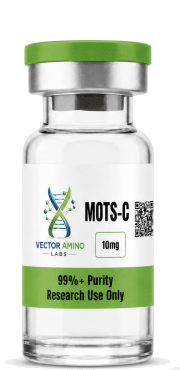
Humanin is often studied alongside another famous mitochondrial-derived peptide: MOTS-c (Mitochondrial Open Reading Frame of the 12S rRNA-c). While both are MDPs with profound metabolic benefits, their primary research applications differ slightly:
- Humanin: Primarily researched for its potent neuroprotective and anti-apoptotic effects, particularly in models of Alzheimer’s and stroke.
- MOTS-c: Primarily researched as an “exercise mimetic,” focusing heavily on skeletal muscle metabolism, AMPK activation, and obesity models.
In 2026, advanced longevity research protocols frequently investigate the synergistic effects of targeting multiple MDP pathways simultaneously.
Conclusion
The discovery of Humanin fundamentally changed our understanding of mitochondrial function, proving that these organelles actively direct cellular survival and aging. By protecting neurons from toxicity, enhancing metabolic function, and directly extending lifespan in biological models, Humanin represents the cutting edge of anti-aging science. For researchers dedicated to understanding and mitigating the diseases of aging, Humanin remains a molecule of unparalleled significance.
All peptides mentioned in this article are available exclusively for research purposes. Not for human consumption.