
Disclaimer: All products mentioned in this article are intended strictly for laboratory research and in vitro use only. They are not for human or veterinary consumption, not for use in diagnostic procedures, and have not been evaluated by the U.S. Food and Drug Administration.
Nicotinamide adenine dinucleotide (NAD+) has emerged as a central molecule in the study of cellular metabolism, mitochondrial function, and the biology of aging. As a vital coenzyme found in all living cells, NAD+ facilitates electron transfer in metabolic pathways and serves as an essential substrate for enzymes that regulate critical cellular processes. Research in 2026 continues to focus on how manipulating NAD+ levels in laboratory models impacts age-related cellular decline.
The Role of NAD+ in Cellular Metabolism
NAD+ exists in two forms: an oxidized and a reduced form (NADH). The ratio of these two forms dictates the redox state of a cell, which controls the metabolic rate and the direction of various biochemical reactions. NAD+ is essential for glycolysis, the tricarboxylic acid (TCA) cycle, and oxidative phosphorylation—the primary pathways through which cells generate adenosine triphosphate (ATP).
Beyond its role in energy production, research over the past two decades has revealed that NAD+ is a crucial co-substrate for several classes of enzymes that are heavily implicated in the aging process and cellular repair mechanisms [1].
Key NAD-Consuming Enzymes in Research
Researchers studying cellular aging focus heavily on three main classes of NAD-consuming enzymes:
1. Sirtuins (SIRTs)
Sirtuins are a family of NAD-dependent protein deacetylases that regulate numerous cellular processes, including gene expression, DNA repair, metabolism, and apoptosis. In mammalian models, SIRT1 through SIRT7 have been identified, with SIRT1 being the most extensively studied in the context of longevity. Research indicates that sirtuin activity is strictly dependent on the bioavailability of NAD+ [1]. When NAD+ levels decline, sirtuin activity decreases, which researchers hypothesize contributes to the cellular hallmarks of aging.
2. Poly(ADP-ribose) Polymerases (PARPs)
PARPs are a family of proteins involved in a number of cellular processes such as DNA repair, genomic stability, and programmed cell death. When DNA damage occurs—from oxidative stress, radiation, or other environmental factors—PARPs consume massive amounts of NAD+ to synthesize poly(ADP-ribose) chains that recruit repair enzymes to the site of damage. In laboratory models of chronic oxidative stress, hyperactivation of PARPs can rapidly deplete cellular NAD+ pools, leading to mitochondrial dysfunction and cell death [1].
3. CD38 and CD157
These ectoenzymes act as NAD+ glycohydrolases, consuming NAD+ to produce cyclic ADP-ribose, a secondary messenger involved in calcium signaling. Recent studies suggest that the expression of CD38 increases significantly in aging tissues, making it a primary driver of the age-related decline in systemic NAD+ levels.
The Age-Related Decline of NAD+
A fundamental observation driving current research is that NAD+ levels decline significantly with age across multiple species, from yeast to rodents to primates. This decline is not uniform across all tissues but is particularly pronounced in highly metabolic organs such as the brain, skeletal muscle, liver, and heart.
Researchers propose two primary mechanisms for this decline:
1. Decreased Biosynthesis: A reduction in the activity of nicotinamide phosphoribosyltransferase (NAMPT), the rate-limiting enzyme in the NAD+ salvage pathway.
2. Increased Consumption: The upregulation of NAD-consuming enzymes, particularly CD38 and PARPs, driven by chronic low-grade inflammation (often termed “inflammaging”) and accumulating DNA damage.
Research Applications and Exogenous NAD+
In laboratory settings, researchers investigate various methods to restore NAD+ pools in cellular and animal models. While much attention has been given to NAD+ precursors like Nicotinamide Riboside (NR) and Nicotinamide Mononucleotide (NMN), the direct application of exogenous NAD+ in research models remains a critical area of study.
In vitro studies utilizing exogenous NAD+ often focus on:
– Mitochondrial Respiration Assays: Measuring oxygen consumption rates and extracellular acidification in cultured cells following NAD+ administration.
– DNA Repair Kinetics: Evaluating the speed and efficiency of DNA damage repair following induced genotoxic stress.
– Cellular Senescence Models: Investigating whether maintaining high NAD+ levels can delay or reverse the onset of the senescent phenotype in primary cell cultures.
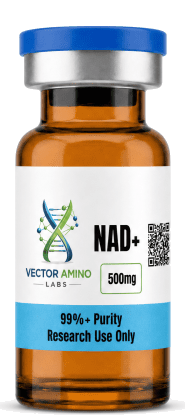
For researchers conducting these highly sensitive metabolic assays, utilizing high-purity, research-grade NAD+ is essential to ensure consistent enzymatic kinetics and reproducible results. Vector Amino Labs provides third-party tested NAD+ specifically formulated for precise laboratory applications.