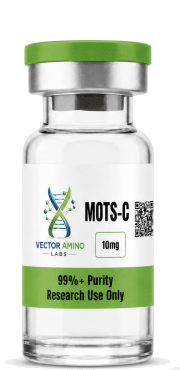


For decades, the scientific community viewed mitochondria purely as cellular power plants, responsible solely for generating ATP. However, the discovery of mitochondrial-derived peptides (MDPs) has fundamentally shifted this paradigm. Mitochondria are now recognized as active signaling organelles that communicate with the nucleus to regulate systemic metabolism. At the forefront of this research in 2026 is MOTS-c (Mitochondrial Open Reading Frame of the 12S rRNA-c), a 16-amino-acid peptide that is moving from theoretical biology into targeted human clinical trials [1].
Disclaimer: The peptides discussed in this article are intended strictly for Research Use Only (RUO). They are not for human consumption, diagnosis, or therapeutic use. The information provided is for educational and scientific research purposes.
The Unique Biology of MOTS-c
Unlike the vast majority of peptides and proteins which are encoded by nuclear DNA, MOTS-c is encoded directly by mitochondrial DNA. This unique origin places it at the center of cellular energy sensing. During periods of metabolic stress—such as exercise, fasting, or caloric restriction—MOTS-c is synthesized and translocates to the nucleus. There, it influences nuclear gene expression to optimize cellular metabolism, enhance glucose uptake, and improve insulin sensitivity [2].
The primary mechanism of action for MOTS-c centers on the activation of AMP-activated protein kinase (AMPK). AMPK serves as a master metabolic switch; when activated, it signals the cell to shift toward more efficient fuel utilization, increasing fatty acid oxidation and glucose uptake while decreasing lipid synthesis. This AMPK-dependent pathway is the same biological mechanism triggered by intense physical exercise, leading researchers to classify MOTS-c as an “exercise mimetic” [3].
Preclinical Findings: The “Exercise in a Syringe” Hypothesis
The initial excitement surrounding MOTS-c was driven by profound results in animal models. A landmark 2021 study published in Nature Communications demonstrated that MOTS-c administration significantly enhanced physical performance across all age groups in mice. The researchers noted improvements in running capacity in young, middle-aged, and elderly subjects, suggesting that the peptide could counteract age-related metabolic decline and muscle loss [4].
Further preclinical research in 2024 and 2026 has expanded on these findings:
- Muscle Preservation: Studies indicate that MOTS-c attenuates immobilization-induced skeletal muscle atrophy by suppressing lipid infiltration and preserving metabolic function [5].
- Cellular Survival: Recent papers have demonstrated that MOTS-c targets specific pathways (such as SLC7A11) to suppress ferroptosis—an iron-dependent form of cell death tied to oxidative stress [6].
- Tissue Resilience: Research involving ischemic soft tissue flaps showed that MOTS-c improved tissue survival by reducing lysosomal membrane permeability and endothelial stress signaling.
The 2026 Human Clinical Trials
While animal data is compelling, mechanism alone does not guarantee human efficacy. The peptide research landscape in 2026 is closely monitoring a pivotal Phase 2a clinical trial (NCT07505745) evaluating MOTS-c in human subjects.
This randomized, double-blind, placebo-controlled study is investigating the effects of MOTS-c in 120 adults diagnosed with prediabetes and overweight or obesity. The trial involves 12 weeks of once-daily subcutaneous administration.
| Trial Parameter | Details |
|---|---|
| Subject Profile | Adults 18-65, BMI 27.0-40.0, diagnosed prediabetes |
| Treatment Protocol | 12 weeks of daily subcutaneous MOTS-c vs. Placebo |
| Primary Endpoint | Change in insulin sensitivity (Matsuda Index derived from OGTT) |
| Secondary Endpoints | HbA1c, fasting glucose, waist circumference, safety profile |
The selection of a prediabetic population is strategic. It allows researchers to measure clear metabolic signals—such as insulin resistance and fasting glucose—before full diabetes develops, without the confounding effects of strong glucose-lowering pharmaceuticals like GLP-1 agonists or SGLT2 inhibitors [1].
Separating Science from Speculation
As MOTS-c gains popularity in biohacking and longevity circles, it is crucial to separate proven mechanisms from premature claims. MOTS-c is not a stimulant, it does not function like semaglutide or tirzepatide (GLP-1/GIP agonists), and it is not a replacement for physical exercise.
While it influences exercise-related metabolic pathways, physical training affects systemic biology in ways no single peptide can replicate. Furthermore, MOTS-c is not FDA-approved for any clinical indication and remains an investigational compound. In July 2026, it was included in the Pharmacy Compounding Advisory Committee (PCAC) review regarding bulk compounding regulations.
The Future of Mitochondrial Medicine
MOTS-c represents a critical step forward in understanding how mitochondria communicate with the rest of the body to manage energy and aging. Whether it ultimately proves effective as a therapeutic intervention for metabolic disease remains to be seen in the upcoming clinical trial data. However, as a research tool, it has already redefined our understanding of mitochondrial signaling, offering a precise molecular mechanism to study the complex relationship between cellular energy, exercise adaptation, and metabolic health.
References
[1] PeptIQ. “MOTS-c and Mitochondrial Metabolism: What the 2026 Human Trial Is Testing.” 2026.[2] Zheng, Y., et al. “The mitochondrial signaling peptide MOTS-c improves myocardial performance during exercise training in rats.” Scientific Reports, 2021.
[3] Reynolds, J.C., et al. “MOTS-c is an exercise-induced mitochondrial-encoded regulator of age-dependent physical decline and muscle homeostasis.” Nature Communications, 2021.
[4] Peptides Lab UK. “MOTS-C UK: Complete Research Guide (2026).” 2026.
[5] PubMed. “MOTS-c attenuates immobilization-induced skeletal muscle atrophy.” PMID: 38170165, 2024.
[6] PubMed. “MOTS-c targets SLC7A11 to preserve spermatogenesis by suppressing ferroptosis.” PMID: 41933740, 2026.